THE QUIET REORDERING: How Regional Networks are Reshaping NHS Pathology Services
Network consolidation has changed who runs laboratory services, how samples move and where the money goes.
THE QUIET REORDERING: How Regional Networks are Reshaping NHS Pathology Services
The brick and mortar foundations of NHS diagnostics are undergoing a massive, silent reorganization. Away from the glare of national political debates, the service is pushing through one of the largest structural overhauls in its history by completely dismantling the traditional hospital laboratory model. In its place, the NHS is consolidating local testing facilities into twenty nine vast, regional pathology networks across England.
This shift marks a total rewrite of how blood tests, tissue biopsies, and virus screenings are processed. Yet, for the millions of patients who rely on these daily tests, the entire transformation is happening completely out of sight.
The Hub and Spoke Blueprint
The driving force behind this reorganization is the hub and spoke model. Historically, nearly every acute hospital operated its own fully staffed, twenty four hour pathology lab. Under the new national strategy, these individual facilities are being replaced by a highly centralized network.
Massive, state of the art hub laboratories are being established to handle the vast majority of routine, high volume processing. Meanwhile, local hospitals are left with scaled back spoke labs, which are strictly reserved for urgent, hot clinician requests that require turnaround times of under an hour, such as emergency blood transfusions or critical intensive care monitoring.
Health planners argue that this centralization creates massive economies of scale. By funneling millions of tests through a single hub, networks can invest in high throughput automation and advanced genetic sequencing machinery that individual hospitals could never afford on their own.
Logistics and Integration Friction
However, merging decades old hospital services into unified regional networks has exposed severe operational friction. The entire model relies on flawless digital connectivity and rapid physical transport, two areas where the NHS faces chronic infrastructure deficits.
A primary hurdle is the fragmentation of Laboratory Information Management Systems. Many hospitals within the newly formed networks use entirely different, incompatible software programs. Pathologists frequently report that tracking a patient sample or viewing results across different hospital sites within the same network requires tedious manual workarounds, completely undermining the efficiency that centralization was supposed to deliver.
Furthermore, moving millions of fragile clinical samples from community clinics and spoke hospitals to a distant hub creates a massive logistical burden. Networks now rely heavily on complex medical courier networks, where any traffic delay, route cancellation, or temperature control failure can compromise samples and delay critical patient diagnoses.
The Human Cost of Efficiency
The structural reordering is also placing an immense strain on the specialized workforce that keeps pathology running. For decades, biomedical scientists, pathologists, and laboratory technicians worked in tight knit hospital teams alongside the doctors treating the patients. The push toward massive hubs has fractured these relationships.
Professional bodies point out that staff are increasingly being asked to relocate to distant centralized hubs, leading to low morale and an exodus of highly experienced personnel. Many workers express frustration that their roles are being transformed from varied clinical diagnostic work into highly repetitive, factory style assembly line processing.
At the same time, the broader NHS staffing crisis leaves these newly formed networks vulnerable. Vacancy rates for qualified histopathologists and clinical scientists remain stubbornly high, meaning that even when a hub is equipped with the latest high speed technology, the system still faces significant backlogs because there are not enough specialists to interpret complex cancer biopsies.
A Fragile Future
The quiet reordering of NHS pathology is an irreversible reality. The financial logic of consolidation and the need to standardize testing across the country mean the old model of the independent hospital lab is gone for good.
Yet, as the final networks attempt to fully integrate their services, health analysts warn that the system remains incredibly fragile. Until the NHS secures the major capital investment needed to fix broken IT links and stabilize its laboratory workforce, the true promise of this quiet revolution will remain trapped in transit.
Published 29 August 2026
The briefing
Join health sector leaders
One email each weekday morning with the reporting, analysis and numbers that matter across the UK health sector.
More from the newsroom
New Hospital Programme timetable slips again as trusts wait on capital allocations
NHS trusts face continued uncertainty over major hospital redevelopment projects as the New Hospital Programme’s revised timetable pushes construction further into the 2030s, while questions remain over when individual schemes will receive confirmed capital allocations.
Callum Reid30 August 2026
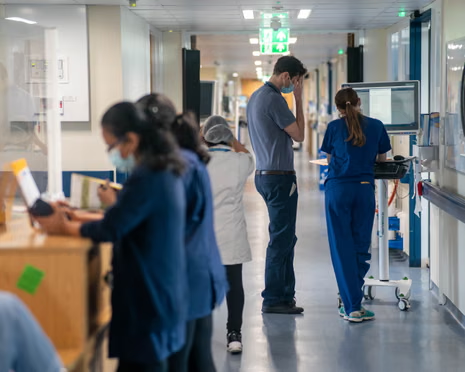
Virtual wards settle into the model that suits them
Virtual wards are entering a more targeted phase as the NHS shifts from rapid expansion towards improving utilisation, with frailty and respiratory pathways among the most established models and clinical workforce, patient selection and rapid escalation remaining critical to success.
Eleanor Whitfield30 August 2026
Electronic patient record rollouts hit contract friction in three regions
NHS trusts are facing growing commercial and legal challenges as major electronic patient record procurements are delayed or disrupted by supplier disputes, highlighting the complexity and risk involved in delivering large-scale digital transformation.
Callum Reid30 August 2026
Pharmacy First referrals rise as NHS shifts more minor illness care away from general practice
Pharmacy First consultations have risen sharply as the NHS encourages GP practices to refer suitable patients to community pharmacies, with growing activity signalling a wider shift in how minor illness is managed across primary care.
Eleanor Whitfield30 August 2026